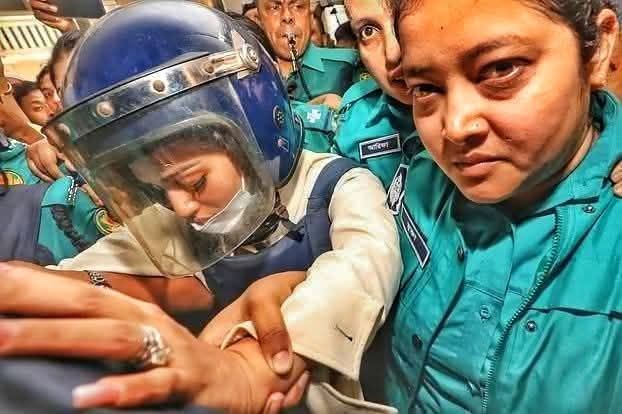
Dhaka, Bangladesh – The arrest and subsequent bail of Bangladeshi actress Nusraat Faria in an attempted murder case linked to the July 2024 anti-government protests have ignited a firestorm of public anger and political division, dominating conversations in local shops, restaurants, and bazaars while fueling heated rants on social media. The controversy has exposed tensions within the interim government, with Cultural Affairs Adviser Mostofa Sarwar Farooki and Home Affairs Adviser Jahangir Alam Chowdhury publicly at odds, and drawn sharp criticism from political parties, artists, and international media.
Arrest at Dhaka Airport
On May 18, 2025, Nusraat Faria, a prominent actress known for her role as former Prime Minister Sheikh Hasina in the 2023 biopic Mujib: The Making of a Nation, was detained by immigration police at Hazrat Shahjalal International Airport in Dhaka as she attempted to board a flight to Thailand. She was arrested in connection with an attempted murder case filed by Enamul Haque, who was shot in the leg during protests in Dhaka’s Bhatara area on July 19, 2024. The case, lodged on May 3, 2025, names 283 individuals, including Prime Minister Hasina and 17 artists, with Faria listed as the 207th accused and labeled a “financial supporter” of the Awami League.
The Dhaka Metropolitan Magistrate Court, presided over by Judge Nasrin Akter, ordered Faria to be sent to jail on May 19, prompting immediate backlash. Her legal team argued she was in Canada from July 9 to August 14, 2024, and could not have been involved in the incident. On May 20, Dhaka Chief Metropolitan Magistrate Court Judge Mustafizur Rahman granted her bail on a 5,000-taka bond after the investigating officer confirmed her absence from Bangladesh during the protests.
Public Outrage and Social Media Storm
Faria’s arrest became the talk of the town, with ordinary Bangladeshis expressing fury in local markets, eateries, and public spaces. Social media platforms erupted with angry rants, with users decrying the arrest as a politically motivated attack on a beloved cultural figure. Fans and supporters, pointing to Faria’s 4 million Instagram followers and her non-political public persona, argued the charges were baseless. “This is a shameful attempt to silence artists,” one X user posted, echoing widespread sentiment. Others celebrated her release, with posts like, “Justice prevails! Nusraat Faria is free!” gaining traction.
The National Citizen Party (NCP) condemned the arrest, calling it a “mockery” of the judicial process and contrasting it with the unhindered departure of former President Abdul Hamid, accused of similar charges. The Bangladesh Cholochitro Shilpi Samiti, the country’s artists’ association labeled the interim government’s actions as “fascist” and unacceptable. The Bangladesh Nationalist Party (BNP), Awami League, and Communist Party of Bangladesh (CPB) also voiced strong disapproval, framing the arrest as an assault on artistic freedom and due process.
Government Advisers at Odds
The interim government, led by Muhammad Yunus, faced internal discord over the issue. Cultural Affairs Adviser Mostofa Sarwar Farooki, a noted filmmaker, described the arrest as an “embarrassing incident” and a “nervous overreaction” linked to public backlash over Abdul Hamid’s recent overseas trip. In a Facebook post, Farooki emphasized the government’s policy against arbitrary arrests without preliminary evidence and expressed hope that Faria would receive legal remedy. “Our primary task is to bring the real perpetrators of the July incident to justice,” he wrote, urging greater sensitivity in handling such cases.
In contrast, Home Affairs Adviser Lieutenant General (Retd.) Jahangir Alam Chowdhury defended the arrest, stating, “If there’s a case against her, what should we do? If we let her go, you would say, ‘Sir, you spared her.’” Chowdhury dismissed Farooki’s criticism as “his own opinion,” highlighting a lack of unity among government advisers. He insisted the investigation was ongoing and that no innocent person would face punishment, but his remarks did little to quell public anger.
International Condemnation
The case drew significant international attention, with at least eight outlets, including Times of India, Business Standard, and Prokerala, covering Faria’s arrest and bail. British journalist David Bergman warned that “simply being a known supporter of the Awami League is enough to make one a target,” raising concerns about arbitrary arrests in Bangladesh. The global media framed the incident as indicative of the interim government’s struggle with “moral and political direction,” amplifying fears of eroding artistic freedom and human rights.
A Polarized Nation
Faria’s arrest and release have underscored deep divisions in Bangladesh’s political and cultural landscape. For many, the case symbolizes a broader crackdown on dissent and artistic expression, particularly targeting those associated with the Awami League. The public’s visceral reaction—evident in heated discussions at local bazaars and scathing social media posts—reflects growing frustration with the interim government’s handling of justice post-July uprising.
As Bangladesh grapples with its political transition, Faria’s case serves as a flashpoint, raising critical questions about fairness, due process, and the role of artists in a polarized society. While her bail has brought temporary relief, the underlying tensions and public discontent are unlikely to fade soon.


 The Asiapost News
Leave a comment