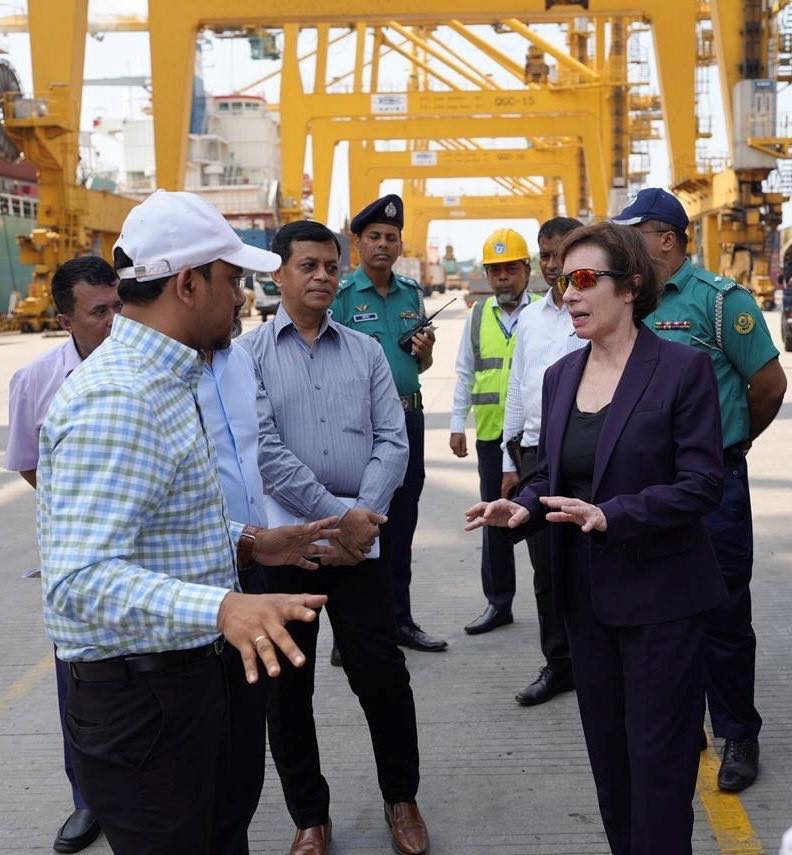
Dhaka, Bangladesh – On 6 May 2025, US Chargé d’Affaires Tracey Ann Jacobson’s high-profile visit to Chittagong Port, Bangladesh’s maritime lifeline, sent shockwaves through an already volatile South Asia, fueling accusations that the United States, in concert with the interim government of Muhammad Yunus, is engineering a dangerous geopolitical gambit. Officially described by the US Embassy as a routine inspection of agricultural shipments—rice, lentils, and vegetable oil from American farmers—the visit’s timing, amid a contentious “humanitarian corridor” to Myanmar’s Rakhine State and escalating unrest in the Chittagong Hill Tracts (CHT), has sparked fierce skepticism. From Dhaka’s streets to New Delhi’s corridors of power, critics see Jacobson’s presence at the port as a brazen signal of US intent to tighten its grip on Bangladesh, infuriating regional heavyweights India, China, and Russia and pushing the nation toward a perilous brink.

A Diplomat’s Visit or a Strategic Ploy?
Jacobson, leading a nine-member delegation to Chittagong Port, which handles 90% of Bangladesh’s $110 billion trade, framed her visit as a goodwill gesture to strengthen US-Bangladesh ties. Yet, the optics of a senior US diplomat overseeing cargo unloading in a strategically sensitive region, just days after reports of armed Arakan Rohingya Salvation Army (ARSA) militants roaming Naikhongchhari Upazila and an alleged abduction by Myanmar’s military, have ignited a firestorm. Social media platforms like Facebook and X erupted, with netizens questioning, “What’s so special about rice unloading that an ambassador travels to Chittagong amidst this chaos?” Political leaders echoed the sentiment, with Bangladesh Nationalist Party (BNP) acting chairman Tarique Rahman, in a 2 May speech at the National Press Club, slamming the interim government’s opacity on foreign engagements as a threat to sovereignty.
The port, a linchpin in the Bay of Bengal’s geopolitical chessboard, is no stranger to international intrigue. Its proximity to Myanmar’s conflict-ridden Rakhine State and its role in the proposed corridor—intended to funnel UN aid but criticized as a conduit for anti-junta forces—makes Jacobson’s visit suspiciously timed. A 28 April Swarajya report alleged US pressure on Dhaka to support Rakhine rebels, a move aligned with the BURMA Act of 2022, which authorizes non-lethal aid to Myanmar’s pro-democracy groups, including the Arakan Army. Analysts suggest the US sees Chittagong as a staging ground to counter China’s regional ambitions, particularly Beijing’s investments in Rakhine’s Kyaukphyu deep-sea port. Jacobson’s presence, far from routine, appears to signal Washington’s intent to secure maritime influence, raising fears of Bangladesh becoming a pawn in a US-China proxy struggle.
Yunus’s Corridor and Domestic Backlash
The corridor, approved by Yunus’s unelected regime, has become a lightning rod for dissent. Former Prime Minister Sheikh Hasina, in a YouTube video, blasted the plan, arguing Myanmar’s Bay of Bengal ports suffice and questioning why Bangladesh should risk its territory. “This is a reckless surrender of our sovereignty,” she declared, a rare point of agreement with her rival Tarique Rahman, who demanded parliamentary approval for such decisions. The corridor’s implications—potentially entangling Bangladesh in Myanmar’s civil war—are compounded by CHT violence, with numerous social media posts showing ARSA and Arakan Army militants infiltrating Bandarban, stoking panic. The interim government’s silence, coupled with local media’s reticence, has deepened public distrust, with many viewing Yunus as a US-aligned figurehead.
NCT Lease and DP World Controversy
Jacobson’s visit also coincides with plans to lease the New Mooring Container Terminal (NCT) to DP World, a Dubai-based operator with a $1 billion investment pledge. Initially proposed under Hasina’s Awami League, the deal, now pushed by Yunus, faces fierce opposition from labor unions and political parties, who warn of job losses and foreign control over a terminal generating Tk 1,216 crore annually. Unsubstantiated X claims, including a 4 May post citing journalist Nabonita Chowdhury, allege DP World’s ties to the CIA and US Navy, framing the lease as a step toward a US-orchestrated proxy war. While no evidence supports these assertions, the UAE’s role as a US ally fuels suspicion, particularly as the lease aligns with US interests in securing Chittagong’s strategic assets.
Regional Powers Bristle
India, China, and Russia are unequivocally livid at these developments. India, Bangladesh’s closest neighbor, views the US’s growing footprint with alarm, fearing disruption to its $18 billion trade and security ties with Dhaka. New Delhi, already wary of Yunus’ perceived pro-Pakistani tilt, sees the corridor and US port presence as a threat to regional stability, especially amid India-Pakistan tensions. China, with $26 billion invested in Bangladesh’s infrastructure and stakes in Rakhine’s ports, perceives the US moves as a direct challenge to its Belt and Road Initiative. Beijing’s state media has warned of “Western interference” destabilizing Myanmar’s border, a veiled jab at Washington. Russia, a key arms supplier to Myanmar’s junta and a critic of the BURMA Act’s sanctions, is incensed by the corridor’s potential to bolster anti-junta forces, accusing the US of fomenting chaos to weaken Moscow’s allies.
A Geopolitical Hodgepodge Unravels
Yunus’s interim regime, propped up by the military but lacking democratic legitimacy, is floundering under the weight of these crises. A US Air Force C-17 landing in Dhaka on 8 May, reportedly from Qatar’s Al Udeid Air Base, and sightings of UN cargo convoys have amplified fears of covert operations. The Dhaka Stock Exchange’s 14.2% year-to-date plunge reflects investor panic, exacerbated by Yunus’s missteps and US maneuvering. Jacobson’s port visit, far from a diplomatic courtesy, has crystallized suspicions of a US-led agenda to reshape South Asia’s power dynamics, with Bangladesh as the battleground. As India, China, and Russia prepare to counter this perceived encroachment, Yunus’ gamble risks plunging the nation into a geopolitical quagmire, where humanitarian pretexts mask a ruthless struggle for regional dominance.



 The Asiapost News
Leave a comment