By Staff Correspondent
May 8, 2025
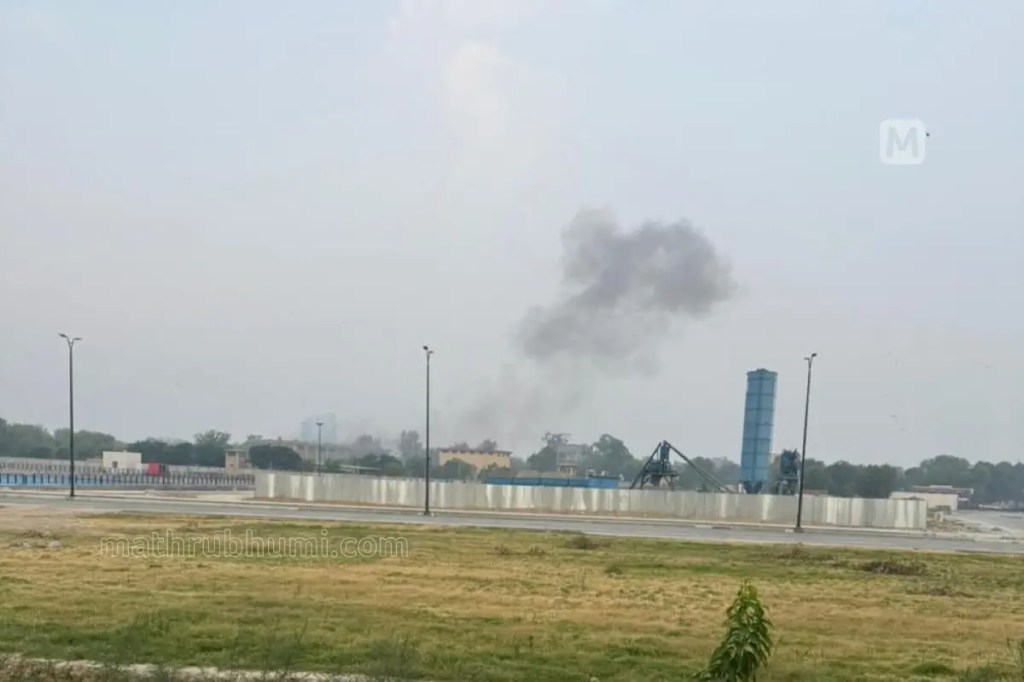
A series of explosions rocked multiple cities across Pakistan on Wednesday, including the cultural hub of Lahore, as tensions with neighboring India reached a dangerous new peak. The blasts, which caused widespread panic and disrupted daily life, came in the wake of India’s missile strikes targeting terrorist camps, plunging the nuclear-armed rivals into their most serious confrontation in decades.
A Day of Chaos
The explosions began early Wednesday, with at least three consecutive blasts reported in Lahore’s upscale Walton Road area, a stone’s throw from sensitive military and civilian installations. Residents described hearing deafening booms, followed by gunfire and emergency sirens, as police and bomb disposal units cordoned off the affected areas. Further explosions were reported in Lahore’s Burki Road, Nasserabad, and Gopalnagar neighborhoods, with one blast occurring near Walton Airport, prompting the temporary closure of the city’s airspace.
Beyond Lahore, the violence spread to Karachi, Rawalpindi, Gujranwala, Chakwal, Attock, Bahawalpur, Mianwali, and Chhor. In Karachi, a confirmed explosion in the Sharafi Goth area of Malir heightened fears, with local police scrambling to secure the site. Pakistan’s military attributed the blasts to attacks by 12 Indian Heron drones, claiming to have shot down 25 drones across nine cities. The government claimed 31 civilian deaths and 46 injuries, including a three-year-old child, though specific casualty figures for the day’s explosions remain unverified.
The Spark: Operation Sindoor
The unrest follows India’s Operation Sindoor, a series of precision missile strikes launched on May 7 targeting nine terrorist sites in Pakistan and Pakistan-occupied Kashmir (PoK). The operation, which India described as a response to the April 22 Pahalgam terror attack that killed 26 tourists in Indian-administered Kashmir, struck locations including Jaish-e-Mohammed’s headquarters in Bahawalpur and Lashkar-e-Taiba’s base in Muridke, just 56 kilometers from Lahore. India claims over 100 terrorists were neutralized, but Pakistan insists the strikes hit civilian infrastructure, including a mosque in Muzaffarabad, PoK.
Pakistan condemned the operation as a “flagrant violation of sovereignty,” with Prime Minister Shehbaz Sharif chairing an emergency National Security Committee meeting to authorize retaliatory measures. The military claimed to have downed five Indian Air Force jets, including three Rafale fighters, while India reported intercepting a Pakistani missile near Amritsar, recovering debris identified as a possible Chinese-made fourth-generation weapon.
A Region on Edge
The escalating violence has brought daily life to a standstill. Pakistan closed its airspace over Lahore, Sialkot, and Karachi, stranding passengers and disrupting trade. International carriers, including Qatar Airways, Etihad Airways, Malaysia Airlines, and Batik Air, suspended or rerouted flights, while Indian airlines issued travel advisories for northern India. In Lahore, hospitals were placed on high alert, and the Board of Intermediate and Secondary Education postponed exams. Schools in six border districts of India’s Punjab state shut down until May 11.
The economic toll is mounting, with Pakistan’s fragile $350 billion economy reeling from a reported stock market crash. The U.S. Consulate General in Lahore directed staff to shelter in place, citing reports of drone activity and possible airspace incursions.
International Alarm
The international community has responded with urgency. The United Nations Security Council held closed-door consultations, and a UN delegation visited damaged sites in PoK. U.S. President Donald Trump offered to mediate, urging both sides to “stop now,” while the UK, China, Russia, Qatar, and the European Union called for restraint. Iran’s Foreign Minister Abbas Araghchi, fresh from talks in Islamabad, was set to visit New Delhi to ease tensions.
Yet, the rhetoric remains heated. A Pakistani minister warned of a “clear and present” threat of nuclear war, a chilling reminder of the stakes in a region where both nations possess nuclear arsenals. India’s External Affairs Minister S. Jaishankar reiterated that New Delhi seeks no escalation but promised a “very firm response” to any further aggression.
Disinformation and Division
As the conflict unfolds, both sides have accused each other of spreading disinformation. Pakistani media shared videos purporting to show civilian casualties, some later debunked as old footage, while India launched fact-checking campaigns to counter claims of indiscriminate strikes. Social media platforms, including Meta, have blocked conflict-related content to curb misinformation, further complicating efforts to discern the truth.
A Familiar Fault Line
At the heart of the crisis lies the decades-old dispute over Kashmir, a region both nations claim in full but administer in part. The Pahalgam attack, blamed by India on Pakistan-based groups, reignited a cycle of violence that has defied resolution since the partition of 1947. Analysts warn that without meaningful dialogue, the current escalation risks spiraling into a broader conflict, with catastrophic consequences for the region and beyond.


 The Asiapost News
Leave a comment