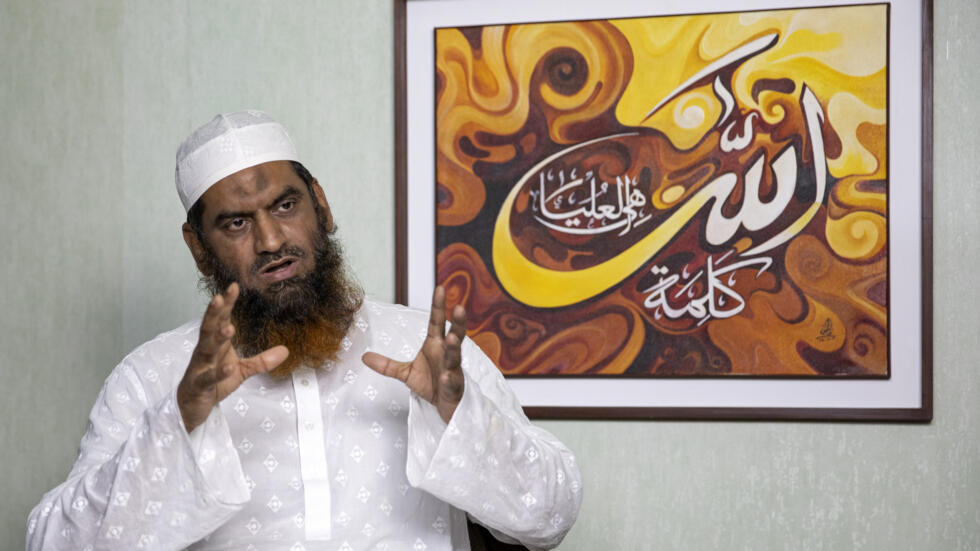
Dhaka, Bangladesh – Mamunul Haque, a polarizing figure and joint secretary-general of Hefazat-e-Islam Bangladesh, has declared his intention to implement Sharia law if his group gains power in upcoming elections, according to an interview with Agence France-Presse (AFP) on April 28, 2025. Haque, a prominent Islamic scholar and leader of the Khilafat Majlis party, expressed confidence in securing parliamentary seats, leveraging the growing influence of Islamist factions in Bangladesh’s volatile political landscape.
Hefazat-e-Islam, a powerful coalition of Islamic seminaries rooted in the country’s Qawmi madrasas, has long claimed to be a non-political entity. However, its actions—marked by violent protests and demands for stringent Islamic governance—suggest otherwise. The group’s resurgence follows the collapse of Sheikh Hasina’s government in August 2024 amid mass protests, creating a political vacuum that Islamists are now exploiting.
“We will implement Sharia law,” Haque told AFP, outlining a vision for an “Islamic welfare state” governed by Quranic principles. “Our goal is to ensure justice for all, guided by the Koran.” He emphasized severe punishments, including making the death penalty mandatory for “insulting Islam, speaking against Allah, or hurting religious sentiments.”
Haque, 52, is no stranger to controversy. In 2021, he was at the center of the infamous “Room 501 scandal” in Sonargaon, Narayanganj, where he was caught with a woman in a luxury resort under compromising circumstances. The woman later accused him of rape, leading to his arrest and a three-year imprisonment. Haque was granted bail in April 2024, just months before Hasina’s ousting, and was acquitted of the rape charges in October 2024. The case, widely dubbed the “501 scandal,” sparked nationwide riots and cemented his notoriety.
On May 3, 2025, Hefazat-e-Islam staged a massive rally at Dhaka’s Suhrawardy Udyan, one of its largest displays of strength in years. The event, attended by thousands, underscored the group’s ability to mobilize its base of over half a million madrasa students and supporters. Haque claimed that fair elections would propel his coalition into parliament, capitalizing on rising religious fervor.
The rise of Hefazat and allied Islamist groups has alarmed Bangladesh’s Sufi Muslims, Hindu minorities, and women’s rights advocates. The group has demanded bans on cultural activities deemed “anti-Islamic,” including singing, drama, women’s football, and kite festivals. Last month, supporters of Haque’s Khilafat Majlis stormed a public library, seizing hundreds of books by revered authors like Rabindranath Tagore and Kazi Nazrul Islam, accusing them of promoting atheism.
Haque has also vehemently opposed gender equality, particularly targeting the Women’s Affairs Reform Commission established by the interim government in November 2024. He called the commission’s 433 recommendations, which include equal inheritance rights for women, a “Western conspiracy” aimed at eroding Islamic family values. “Equality is a Western ideology,” he stated, echoing sentiments from other Hefazat leaders. The group issued an ultimatum to dissolve the commission by May 3, threatening severe repercussions.
Bangladesh’s constitution enshrines secularism, nationalism, socialism, and democracy as core principles, but Hefazat insists public sentiment favors Islamic law. Haque’s rhetoric, including calls for a “jizya tax” on non-Muslims—described as a “service charge” for living in Bangladesh—has intensified fears of sectarian strife.
The interim government, led by Muhammad Yunus, has faced criticism for engaging with Haque and Hefazat, particularly after a controversial meeting on August 31, 2024, to discuss election reforms. Critics argue that Yunus’s tolerance of Islamist groups, coupled with the lifting of a ban on Jamaat-e-Islami in August 2024, signals a dangerous shift toward religious conservatism.
As Bangladesh gears up for elections expected between December 2025 and June 2026, the growing clout of Hefazat-e-Islam and its firebrand leader poses a formidable challenge to the nation’s secular fabric. Haque’s unapologetic push for Sharia law, backed by a fervent base, signals a turbulent road ahead for Bangladesh’s fragile democracy.


 The Asiapost News
Leave a comment