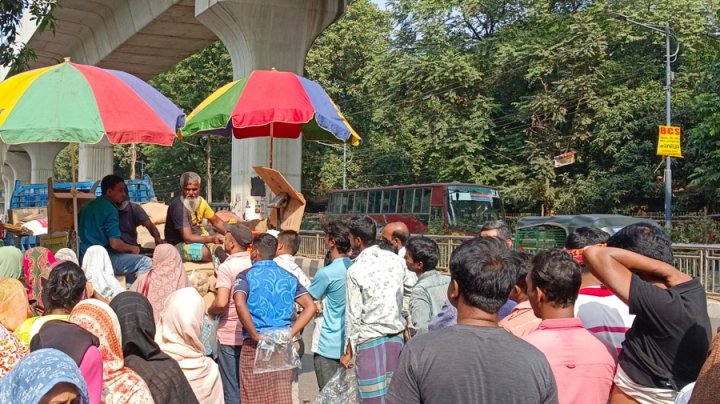
The Trading Corporation of Bangladesh (TCB) has seen a surge in demand for its subsidized essential commodities, with long queues in Dhaka’s Luxmibazaar area reflecting the growing financial pressures on ordinary citizens. Middle-class families and students from various colleges and universities have joined the traditionally low-income beneficiaries of TCB’s programs, as the rising cost of essential goods pushes more people to seek relief.
TCB, a state-owned entity under the Ministry of Commerce, has been a cornerstone of market stability since its establishment in 1972. With its primary mission to shield consumers—particularly those from low-income backgrounds—from the harsh impacts of price surges and supply shortages, TCB has consistently served as a lifeline for the nation’s most vulnerable, embodying the role of a savior for those in need.
Crowds Overwhelm TCB Trucks
Each day, individuals from diverse professions stand in TCB’s special truck sales lines to purchase staples like rice, lentils, potatoes, and cooking oil at subsidized rates. However, the demand far exceeds the supply. According to TCB sources, their trucks operate in five locations across Dhaka, serving a limited number of customers due to stock constraints.
Among TCB’s offerings, essential items are sold at significantly reduced prices: edible oil at BDT 100 per liter, lentils at BDT 60 per kilogram, rice at BDT 30 per kilogram, and potatoes at BDT 40 per kilogram. Purchasing items from TCB can save up to 40% compared to prices in the retail market.
Students Among Those Seeking Relief
Hasan, a student at Jagannath University and a resident of Luxmibazaar, said the situation has become untenable. “The prices of essential products are higher than ever. It’s almost impossible to buy from regular shops. That’s why we’ve turned to TCB,” he told reporters.
Enamul Haque, a student of Kabi Nazrul Government College, noted that expenses for his shared accommodation, or “mess,” have risen sharply. “What used to cost BDT 3,000 now requires nearly BDT 5,000. TCB’s goods are a lifeline for us, and we now shop there twice a week to save money,” he explained.
Another student from Jagannath University shared how her hostel decided to rotate responsibilities for standing in TCB lines weekly. “I missed an hour and a half of class today to get groceries. It’s not ideal, but it’s necessary,” she said, adding that market prices remain out of reach for many.
Demand for Broader Offerings
TCB’s limited range of goods has sparked calls for expansion. Students and low-income individuals have urged the government to include fish, meat, and vegetables in TCB’s subsidized sales.
Khadijatul Kobra, a Dhaka University student, lamented the high prices in local markets. “It would make a big difference if TCB also sold fish, meat, and vegetables. We are struggling to afford these items,” she said.
Morshed Alam, another TCB customer, tearfully recounted his inability to buy fish for his daughter. “She begged for fish, but I couldn’t afford it. It’s heartbreaking as a parent,” he said.
Challenges for TCB
Jamil Ahmed, a TCB truck operator, said the organization is ready to expand its offerings if directed by the authorities. “If TCB includes fish, meat, and vegetables, we’ll ensure these are distributed efficiently,” he told reporters.
The increasing dependence on the Trading Corporation of Bangladesh (TCB) underscores the deepening financial hardships faced by a significant portion of the population. As essential commodities become increasingly unaffordable, even for middle-class families and students, TCB has emerged as a critical safety net, providing subsidized goods to those struggling to make ends meet. However, while these initiatives offer temporary relief, they also reflect a larger systemic issue within the economy.
There is growing pressure on the government to not only maintain TCB’s efforts but also to take proactive steps to address the underlying causes of inflation and supply chain disruptions. Without tackling these root causes, the reliance on such programs may only intensify, placing further strain on an already overstretched system.



 The Asiapost News
Leave a comment