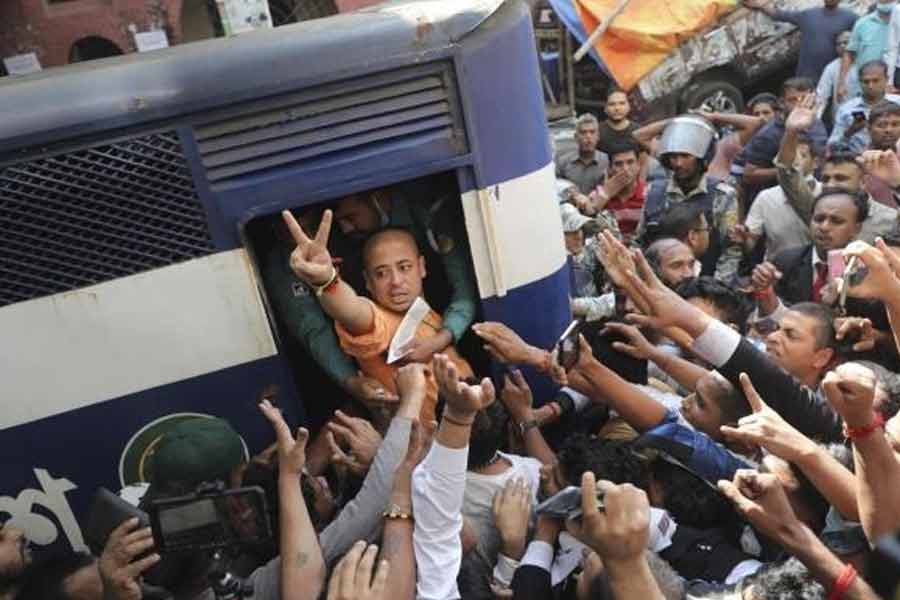
Tensions between India and Bangladesh have flared after the arrest of Hindu monk Chinmoy Krishna Das Brahmachari on sedition charges. The monk, who has been a vocal advocate for minority rights in Bangladesh, was detained at Dhaka airport earlier this week. A Bangladeshi court denied him bail on Tuesday, triggering widespread protests across the country and prompting a strongly worded response from New Delhi.
India Criticizes Arrest, Calls for Minority Protection
Das, a prominent figure in the Bangladesh United Sanatan Jagaran Jote and associated with ISKCON (International Society for Krishna Consciousness), has been at the forefront of rallies calling for greater safety and security for Hindus in Bangladesh. He was arrested while traveling to Chattogram and is accused of sedition for allegedly disrespecting Bangladesh’s national flag during a rally in October.
India’s Ministry of External Affairs (MEA) expressed grave concern over the arrest and subsequent denial of bail. In its statement, the MEA highlighted a pattern of attacks on religious minorities in Bangladesh and criticized the charges against Das as politically motivated.
“It is unfortunate that while perpetrators of attacks on minorities remain at large, a religious leader advocating peaceful demands has been targeted,” the MEA stated.
The Indian government urged its Bangladeshi counterpart to safeguard the rights and security of Hindus and other minority communities, emphasizing their right to peaceful assembly and expression.
Bangladesh Defends Actions, Rejects India’s Criticism
In response, Bangladesh’s Ministry of Foreign Affairs dismissed India’s concerns, categorizing them as interference in its internal affairs. A statement issued by Dhaka expressed dismay at what it termed “unfounded” and “misrepresentative” claims from New Delhi.
“Such statements contradict the spirit of friendship and cooperation between our nations. The government of Bangladesh is committed to ensuring the safety and security of all citizens, irrespective of their religious identity,” the statement read.
Bangladesh defended Das’s arrest as being based on specific charges related to sedition, asserting that the matter was being handled lawfully through the judicial system.
Protests Erupt Across Bangladesh
Das’s court appearance on Tuesday was marked by heavy security, with police and Border Guard Bangladesh (BGB) personnel stationed to prevent disruptions. His supporters, including lawyers and members of the Hindu community, gathered outside the court, chanting slogans and demanding his release.
Despite an impassioned appeal from his defense team, the court rejected Das’s bail application, citing legal requirements. The judge ordered his detention and ensured that he would be allowed to practice religious rituals in custody in accordance with the Jail Code.
Protests escalated following the court’s decision, with demonstrations reported in Dhaka, Chattogram, Khulna, Comilla, Rangpur, Dinajpur and other cities. In Dhaka, security forces used sound grenades and batons to disperse protesters who had blocked the movement of the prison van carrying Das. Amid the chaos, the monk addressed his followers from inside the van, urging restraint:
“We are not against the state or the government. Hindus are a part of this nation. Let us protest peacefully, without destabilizing the state or our coexistence.”
Rising Tensions Over Minority Rights
Das’s arrest has reignited concerns about the treatment of religious minorities in Bangladesh. India has previously raised the issue of violence against Hindus, with Prime Minister Narendra Modi personally addressing it in a phone conversation with Bangladesh’s interim Chief Adviser, Professor Muhammad Yunus.
The MEA cited numerous documented cases of attacks on Hindus, including incidents of arson, vandalism, and desecration of temples and deities. New Delhi has criticized Dhaka’s perceived inaction in bringing perpetrators to justice, contrasting it with the swift charges leveled against Das.
A Delicate Diplomatic Balance
The incident has added a new layer of complexity to the already sensitive India-Bangladesh relationship. Both countries share deep cultural and historical ties, but issues of minority rights and political unrest in Bangladesh have occasionally caused friction.
Observers note that this controversy comes at a particularly volatile time for Bangladesh, where an interim government led by Nobel laureate Muhammad Yunus is already grappling with political instability and accusations of human rights violations.
The treatment of Das and the broader implications for minority rights have become flashpoints in this broader narrative. New Delhi’s intervention reflects its growing unease about the situation in Bangladesh, where communal tensions and political unrest risk spiraling into a larger crisis with regional ramifications.
Looking Ahead
The protests following Das’s arrest show no signs of abating, with community leaders and rights activists calling for his immediate release. Meanwhile, Bangladesh’s government has reiterated its commitment to upholding the rule of law, insisting that the charges against Das are legitimate and unconnected to his religious or political affiliations.
As the situation unfolds, international observers are watching closely, with many urging both nations to prioritize dialogue and cooperation to prevent further escalation. How this dispute is resolved will have significant implications for the future of India-Bangladesh relations and the safety of religious minorities in the region.



 The Asiapost News
Leave a comment