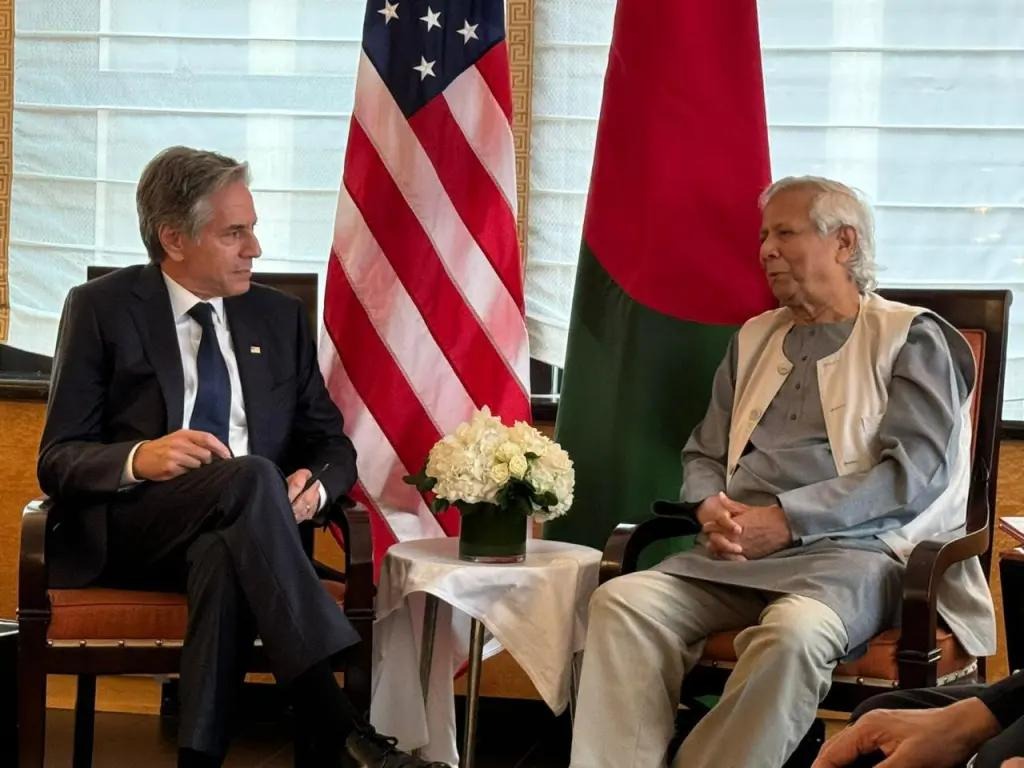
Exposed: US Government’s Hidden Agenda to Destabilize Bangladesh’s Political Landscape
An investigative report by The Grayzone has alleged that the United States played a covert role in the recent removal of Bangladeshi Prime Minister Sheikh Hasina, accusing Washington of deploying a mix of cultural diplomacy, activist training, and covert funding to destabilize her government. These claims, based on leaked documents, have sparked intense debate about foreign interference in Bangladesh’s politics.
The Allegations
The report suggests that the U.S.-funded International Republican Institute (IRI), a Republican Party-affiliated organization under the National Endowment for Democracy (NED), orchestrated efforts to undermine Hasina’s administration. According to leaked documents marked “confidential,” IRI trained activists, funded opposition parties, and promoted mass protests in the lead-up to the August 2024 coup.
The documents claim IRI recruited a network of youth leaders, artists, and marginalized community activists, including rappers, LGBTQI advocates, and ethnic minority leaders, to push for a “power shift” in the country. Programs reportedly included workshops on digital tools for activism, art-based advocacy, and public performances designed to promote dissent against Hasina’s government.
On August 5, after months of street protests, the military seized power, forcing Hasina to flee to India. Western media celebrated the coup as a victory for democracy, but the The Grayzone report portrays it as the culmination of years of U.S.-backed destabilization efforts.
IRI’s Role in Destabilization
The leaked files reveal that IRI had been active in Bangladesh since 2003 but intensified its operations after Hasina’s sweeping electoral win in 2018. That year, her Awami League secured an overwhelming victory, which IRI viewed as a sign of her government’s growing entrenchment. To counter this, IRI allegedly launched a series of covert initiatives:
- Youth Mobilization: Inspired by student protests in 2018, IRI began training young activists, providing them with tools to amplify dissent through social media. The report notes that live-streamed videos of police actions and viral protest anthems significantly expanded the reach of anti-government movements.
- Cultural Diplomacy: IRI funded artists, musicians, and performers to create politically charged content. One example is rapper Toufique Ahmed, who produced music videos addressing social issues like poverty and corruption, with the goal of fostering dissatisfaction with Hasina’s administration.
- Marginalized Communities: IRI reportedly engaged LGBTQI activists and ethnic minority leaders as “shock troops” to advocate for reforms and pressure the government. It hosted transgender dance performances to raise awareness and build networks within these communities.
Between 2019 and 2020, IRI issued over 200 grants to support activism and art projects, which it claimed were viewed nearly 400,000 times. It also conducted extensive research, interviewing hundreds of activists and identifying over 170 individuals to support its mission of destabilizing Bangladesh’s political landscape.
Washington’s Alleged Motives
Hasina’s government had a history of resisting U.S. demands, including the establishment of a military base in the Bay of Bengal, a key part of Washington’s Indo-Pacific strategy to counter China. Her refusal reportedly led to increasing tensions with the U.S., which viewed her alignment with India as an obstacle to its regional ambitions.
Muhammad Yunus, the Nobel laureate who has taken over as the leader of Bangladesh’s interim government, has long-standing ties to the U.S. and the Clintons. Yunus, a pioneer of micro-lending and a frequent attendee of the Clinton Global Initiative, has acknowledged the protests that led to his rise were “meticulously designed.” Critics argue that his ascent signals a realignment of Bangladesh’s policies toward U.S. interests.
Aftermath of the Coup
Since the military takeover, Bangladesh has descended into political turmoil. Opposition groups, led by the Bangladesh Nationalist Party (BNP), have taken to the streets, sparking violent clashes. Over 150 journalists have been arrested, and the military has been granted sweeping powers to suppress dissent.
Meanwhile, Yunus’s interim government has pledged to restore stability but faces skepticism. Although it initially promised to hold elections within months, experts fear the regime could extend its rule for years. The Guardian has reported that the unelected administration may remain in power for up to six years.
IRI’s Strategy and BNP’s Role
The leaked documents also shed light on the BNP’s struggles. Once a dominant political force, the BNP had become increasingly marginalized under Hasina’s rule, with declining popularity and internal disarray. IRI viewed the BNP as too weak to win elections but identified it as the most viable vehicle for a “power shift.”
To bolster the opposition, IRI funneled millions of dollars into advocacy campaigns, including training for activists and the production of political content. This strategy aimed to bypass traditional electoral processes and rely on street mobilizations to force change.
While the State Department denies any involvement in Hasina’s removal, critics argue the leaked documents paint a different picture. They suggest U.S. agencies collaborated with civil society actors and opposition groups to undermine Hasina’s government and install a more U.S.-friendly administration.
A New Era for Bangladesh?
As Yunus signals his willingness to work closely with Washington, analysts suggest Bangladesh’s political future will be closely tied to U.S. strategic interests. At a recent business forum in New York, Yunus emphasized the country’s readiness to support U.S. supply-chain diversification under its Indo-Pacific strategy.
The situation in Bangladesh raises broader questions about the ethics of foreign intervention and the impact of regime change campaigns on democratic governance. While the full extent of U.S. involvement remains unclear, the leaked documents highlight the deep and often controversial role foreign actors can play in shaping the political destiny of nations.



 The Asiapost News
Leave a comment