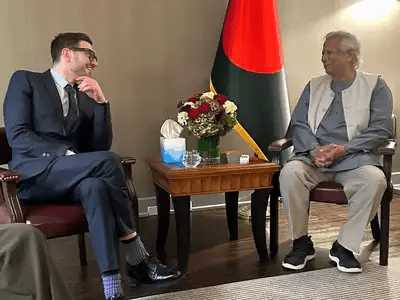
On October 2, Alex Soros, the son of billionaire philanthropist George Soros, met with Muhammad Yunus, Bangladesh’s interim leader and Nobel Peace Prize laureate. Taking to Instagram to share the encounter, Alex Soros expressed admiration for Yunus, calling him an “old friend of my father and the foundation.” He lauded Yunus’ leadership, writing, “Delighted to see Nobel Prize winner Professor Muhammad Yunus, interim leader of Bangladesh, who stepped in to lead the country towards a peaceful future based on equity and fairness.”
The meeting between Yunus and Soros has drawn considerable attention, underscoring Yunus’ connections to the Soros family and raising questions about the influence of global philanthropic networks on Bangladesh’s political landscape.
A Decades-Old Financial Bond
The relationship between Yunus and George Soros dates back to 1999, when Yunus’ Grameen Telecom, a non-profit offshoot of Grameen Bank, secured an $11 million loan from the Soros Economic Development Fund, part of the Open Society Foundations. The funds enabled Grameen Telecom to acquire a 35% stake in Grameenphone Ltd., which would go on to become Bangladesh’s largest telecommunications provider.
This pivotal investment not only established Grameenphone as a market leader but also bolstered Yunus’ reputation as a visionary capable of blending business with social impact. Grameen Telecom, leveraging profits from Grameenphone, reinvested in social and welfare projects across the country. The loan was fully repaid, yet Yunus’ association with the Soros family has remained a point of contention, especially among his political opponents who view such foreign ties with skepticism.
Yunus at the Crossroads of Power and Criticism
Yunus, celebrated globally as the “banker to the poor,” has faced mounting scrutiny at home, particularly in the wake of his appointment as interim leader following the ouster of Prime Minister Sheikh Hasina. Critics argue that Yunus’ foreign affiliations, including his ties to the Soros family, could exert undue influence on Bangladesh’s internal affairs.
This isn’t the first time Alex Soros has attracted attention for his high-profile meetings. Just recently, he met Democratic vice-presidential nominee Tim Walz, further solidifying his growing influence as the head of the $25 billion Open Society Foundations, a position he assumed in 2023 after his father, George Soros, formally transferred control.
Who is Alex Soros?
Born in 1985, Alex Soros has stepped out of his father’s shadow to lead one of the world’s largest philanthropic organizations. With degrees from New York University and the University of California, Berkeley, Alex has championed progressive causes including human rights, climate change, and democratic governance.
Taking the reins of the Open Society Foundations marked a generational shift for the Soros philanthropic empire. Alex has maintained his father’s legacy while introducing a modern approach to tackling global challenges, earning recognition as a significant figure in international advocacy.
Who is Muhammad Yunus?
Muhammad Yunus is a celebrated Bangladeshi economist and social entrepreneur, renowned for pioneering microfinance and microcredit—innovative concepts that offer small loans to underserved communities, especially women, to foster economic self-sufficiency. Born in 1940 in Chittagong, Yunus earned a PhD in economics from Vanderbilt University before founding Grameen Bank in 1983.
The bank’s success earned Yunus the Nobel Peace Prize in 2006, and his work has since been replicated globally as a model for poverty alleviation. Beyond microfinance, Yunus is a leading advocate for “social business,” where profits are reinvested to address societal challenges rather than enriching shareholders.
In 2024, Yunus stepped into the political spotlight as interim leader of Bangladesh following widespread protests and political unrest. While he remains an icon of social innovation, his tenure as interim leader has invited scrutiny over his global alliances and their potential implications for Bangladesh’s sovereignty.
Implications of the Soros-Yunus Alliance
The meeting between Alex Soros and Muhammad Yunus highlights the intersection of global philanthropy and national politics in Bangladesh. With Yunus navigating the complexities of interim leadership and Alex Soros extending his family’s influence, questions linger about the role of foreign networks in shaping the country’s future.
For Yunus, this relationship serves as both an asset and a liability, emblematic of his global stature yet a focal point for critics wary of external interference. As Bangladesh charts its path forward, the Yunus-Soros connection underscores the delicate balance between leveraging international support and maintaining national independence.

 The Asiapost News
Leave a comment